
As an official agency under the Ministry of Cooperatives and SMEs (Kemenkop UKM), Smesco is committed to supporting the development of small and medium-sized enterprises (SMEs) across Indonesia.
Among the various plantation commodities available, the *lontar* (sugar palm) stands out as a key product with significant potential to drive local economic growth. *Lontar* trees are commonly found in dry coastal regions, such as East Nusa Tenggara (NTT).
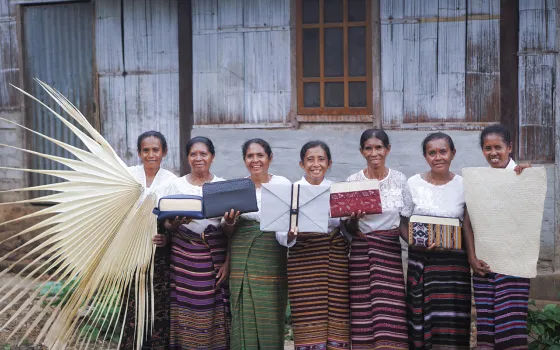
In NTT, the *lontar* tree serves as a symbol of sustainability for the people of East Flores due to its multifaceted utility. Its sturdy trunk is frequently used as a material for construction or bridges, while its fronds and leaves serve as raw materials for woven handicrafts.
To date, there are over 15 economically valuable products derived from the *lontar* palm. Female weavers in NTT contribute 27 percent of the total value generated by these products.
Recognizing this potential, the social enterprise Du Anyam has empowered more than 1,600 female weavers across approximately 54 villages in NTT, South Kalimantan, and Papua. The creations of these local weavers are high-quality woven goods that have successfully penetrated both national and international markets.
**Economic Potential and Opportunities of the *Lontar* Palm**
Research indicates that approximately 5 million *lontar* trees grow naturally across 22 regencies in NTT. Eighty percent of these trees are over 10 years old, thereby offering significant economic value-added potential.
The primary product derived from the *lontar* palm is *nira* (sap), obtained by tapping the tree's blossoms. On average, a farmer taps 25 trees daily, yielding 3.5 liters of sap per tree per day. This results in a total daily production of approximately 8.5 liters of sap, which can be sold for direct consumption or for use in the bioethanol industry.
Given the competitive advantages of its various derivative products, the *lontar* palm represents a valuable opportunity for local residents to increase their income. Recognizing the growing market demand for *lontar* (palmyra palm) products, Smesco identifies a need for strategic measures and multi-stakeholder collaboration to ensure production sustainability and environmental preservation. Such efforts can also drive local economic growth and improve community welfare in East Nusa Tenggara (NTT).
"Rising market demand—at local, national, and global levels—for *lontar*-derived products necessitates serious multi-stakeholder efforts to sustain production in NTT. Furthermore, developing this sector offers a strategic solution to enhance the well-being of the East Nusa Tenggara community, particularly in navigating economic challenges," stated Wientor Rah Mada in an official release in Jakarta on Monday (June 24, 2024).
**2024 *Lontar* Economic Outlook Focus Group Discussion (FGD)**
To establish a community-based economic ecosystem in NTT, Smesco Indonesia and Du Anyam organized the 2024 NTT *Lontar* Outlook Focus Group Discussion (FGD).
As a driver of the entrepreneurship ecosystem, Krealogi by Du Anyam acts as a community enabler, actively participating in capacity building for weavers, product innovation, and digital integration via its application.
This initiative stems from a strategic collaboration involving the Ministry of Cooperatives and SMEs (KemenKop UKM), Smesco Indonesia, Du Anyam, Krealogi, Koalisi Ekonomi Membumi, Supernova Ecosystem, the NTT Provincial Government, Dekranasda, state-owned and private financial institutions, academics, industry players, and logistics partners, all working together to meet export market demand for *lontar*-derived products.
The 2024 *Lontar* Economic Outlook FGD was held on June 27, 2024, in Kupang. This discussion aims to:
Map the governance of the *lontar* (palmyra palm) as a strategic commodity in NTT
Formulate a partnership scheme that offers solutions for sourcing *lontar* raw materials
Encourage increased research and technology development related to *lontar*
Establish financing and logistics partnerships
Update the database of productive economic activities involving *lontar*-based MSMEs
Hanna Keraf, founder of Du Anyam and Director of Community and Partnerships at Krealogi, noted that there is immense export market potential for Asian producers of natural fiber-based products.
By 2025, the income of the communities supported in NTT is projected to double compared to the previous period. However, challenges regarding raw material availability, data and research on *lontar* development, supply chain management, and the production ecosystem still need to be addressed. It is hoped that this cross-sector discussion and Focus Group Discussion (FGD) will serve as a bridge for communication.
Preserving the *lontar* tree is not merely about environmental conservation; it is also about preserving culture. Let us work together to preserve the *lontar* tree for the benefit of us all.
Let’s Move Empower Together!